
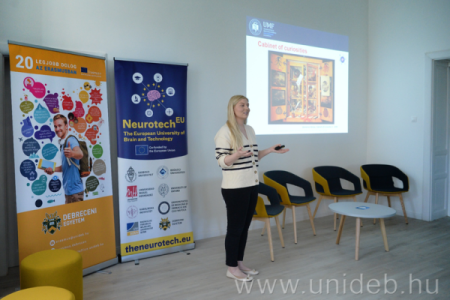
According to a group of researchers from the University of Cluj-Napoca, tracking the movements of human eyes may turn out to be a useful diagnostic method for treating a number of diseases of nervous origin in the future. The experts gave an account of the progress of their research project by delivering a presentation at the series of events Brain Research Week hosted by their colleagues of the University of Debrecen.
Hírek Research címkével

The University of Debrecen (UD) is intent on putting the study of biodiversity, climate change, sustainable development and water management on a new footing. As it was announced at a press conference on the subject, the unit called Biodiversity, Water Management and Climate Change Coordination Research Centre, which was established last year, would play a key strategic part in this process.

The foundation stone of the building of National Manufacturing-Research-Education Plant and Faculty of Pharmacy has been laid. The most recent facility of the University of Debrecen is located in the industrial park of our institution on the street called Vezér utca. State Secretary for Innovation and Higher Education Balázs Hankó, who attended in the event, praised the activities of the University of Debrecen linking education and research and development as a model to follow.

For the first time in the world, researchers at the Center for Agricultural Genomics and Biotechnology of the University of Debrecen use DNA chip technology in the genetic testing of domestic pigeons. The new analytical method helps the genetic uptake of the species significantly. The findings of the research project were recently published in the periodical Saudi Journal of Biological Sciences.
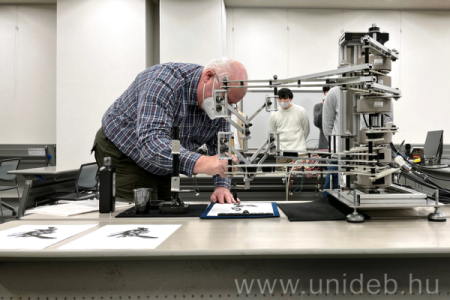
The delegation of the Faculty of Engineering and the NeurotechEU Social Robotics research group discussed research cooperation and joint projects with Japanese partners. The six delegates visited five Japanese universities and a research institution.

In the framework of the European Cooperation in Science and Technology, researchers of the Centre for Agricultural Genomics and Biotechnology have studied the molecular background of plants’ memory. The findings have been published in Trends in Plant Science, the most prestigious journal in the field.

The Faculty of Health Sciences of the University of Debrecen offers up-to-date knowledge, practice-oriented education and a new master’s course to students, who can study in Debrecen, Nyíregyháza and Szolnok.
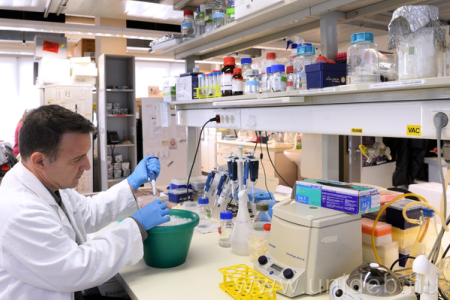
The findings of the researchers of UD may help develop new therapies for asthma. The project, which was launched several years ago, focused on the study of macrophage polarisation. The findings have been published in Immunity, one of the most prestigious journals in the field of immunology.
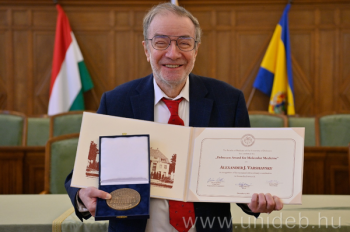
The Faculty of Medicine of the University of Debrecen has awarded molecular biologist Alexander Varshavsky the Debrecen Award for Molecular Medicine this year. Professor Varshavsky, who lives and works in the United States, owes his international fame chiefly to the discovery of protein degradation processes realized through the so-called ubiquitin system. This year’s awardee received the recognition on Tuesday at a ceremony held in the Aula [University Hall] venue of the Main Building, where he also delivered a lecture on his scientific achievements.

As a recognized member of Microsoft’s Learn for Educators Program, the Faculty of Informatics (FI) of the University of Debrecen also participated in the professional summit held in Warsaw, Poland, and hosted by the global US-based company, where FI presented its scientific and educational achievements with the support of Microsoft as one of the outstanding partners of this international corporation.