
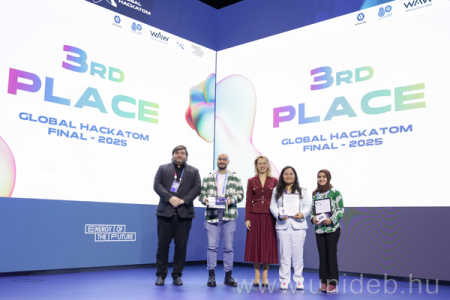
The team from the University of Debrecen came third in the international Hackatom problem-solving competition. The world finals were held in Moscow as part of the World Atomic Week program series and international forum. The two members of the team, called IsotopeX, are students at the Faculty of Health Sciences.
Hírek Innovation címkével

What does Client Gate have to do with Tibor Kapu becoming an astronaut? What could have silenced the otherwise rather talkative Shux and Tibor Kapu for six minutes on board the spacecraft named Grace? What does it mean in terms of space travel when a file upload gets stuck? These, among other things, as well as the process of becoming an astronaut and the special professional relationship between them were the topics discussed by research astronaut Kapu and astronaut candidate Gyula Cserényi in the theater hall of the University of Debrecen on Wednesday at an interview conducted by Vice Rector for Academic Affairs László Csernoch.
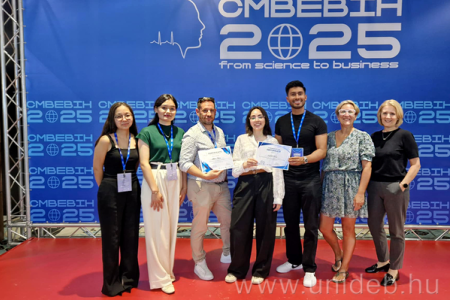
Team Veritas from the University of Debrecen won the international ideas competition OncoTrack Hackathon held between September 11 and 13, where staff members from Innovation Ecosystem Center assisted the Debrecen team on site.

A new and innovative financial product has been developed by an expert at the Faculty of Economics and Business at the University of Debrecen in the framework of a university collaboration. Patrícia Becsky-Nagy, Head of Department of Finance, and her research colleagues affiliated with Corvinus University of Budapest have created an innovation in the field of call option swaps by laying the theoretical foundations for a new financial product. The research results, which include complex mathematical derivations, were published in the prestigious scientific journal Finance Research Letters.
Topics such as the harmonization of traditional Chinese medicine (TCM) with medical research, the role of artificial intelligence and network pharmacology, as well as opportunities in next-generation pharmaceuticals and theranostics, were discussed at the Doctor Honoris Causa Symposium on Thursday. At the scientific session, Professor Shao Li– member of the European Academy of Sciences and Arts and Director of the Interdisciplinary Research Institute of Traditional Chinese Medicine at Tsinghua University – presented his research findings. He received an honorary doctorate from the University of Debrecen on Friday.

Emerging seed leaves and fresh data are among the results of research measurements from the International Space Station that keep coming in constantly. In the scientific portfolio of Axiom Mission 4, the University of Debrecen is a participant in two projects: the first one is part of HUNOR Hungarian Astronaut Programme, where UD experts conduct research on brain hemodynamics, and the second one is on plant germination, micro-green cultivation and leaf development.

Genetic and genome biology research was the focus of the Central European Genome Stability Meeting, an international conference organized by the Faculty of Pharmacy of the University of Debrecen. The English-language event, held at the Learning Center, featured 32 experts giving presentations in 7 sessions and seeking collaboration opportunities.

Shaping attitudes, commercializing research results, supporting student ideas, developing networks and communities, and having an international presence – the director of the Innovation Ecosystem Centre shared their goals with the Press Centre.

The Faculty of Pharmacy of the University of Debrecen (DE GYTK) has been active in researching therapeutic options and compounds that could later be used to develop a new generation of drugs to treat certain cancer and immunological diseases, diabetes or even Alzheimer's. The most recent world-leading findings and results of this research team have been published in one of the most prestigious scientific journals.

How could artificial intelligence (AI) prove to be helpful in finance, accounting and business administration? How can the appropriate use of AI affect the economic situation of businesses in our region? These are but two of the questions that the Faculties of Economics and Business of the University of Debrecen and the University of Oradea are exploring in a joint program launched recently. In addition to implementing knowledge transfer, this one-year project also aims to deepen cross-border professional and academic connections.